
Health and medical geography
Building a sustained programme around spatial health, population, environment, and place.
Academic experience, research interests, professional links, collaborators, and curriculum vitae.
Curriculum vitae
Building a sustained programme around spatial health, population, environment, and place.
Connecting Bayesian spatiotemporal inference, interpretation, software, and applied research.
Turning methodological work into tools, documentation, cases, and learning resources.
Advancing rigorous, explainable evidence for public-health action and equitable planning.
This article is divided into 2 pages. Use Previous / Next or the table of contents to move between pages.
E-mails: chaosong@scu.edu.cn ; chaosong.gis@gmail.com
• Associate Professor, West China School of Public Health (West China Fourth Hospital) , Sichuan University (SCU). Research and Teaching on Health and Medical Geography, Spatial Health Statistics, and GIScience .

• PI, HEOA-West China Health & Medical Geography Group , within HEOA (Healthcare Evaluation and Organizational Analysis) Group.
• Research fellow, Institute for Healthy Cities, Sichuan University (SCU) .
Developer of the BSTVC model (spatiotemporal heterogeneous perspective for analyzing influencing factors, identifying key drivers, and making dynamic predictions, all within a unified ‘full-map’ framework) and its R package.
• ORCID
My research pursuits are anchored in Geographic Information Science (GIScience), encompassing spatial, spatiotemporal, and Bayesian statistics. These disciplines are integral to my work in health and medical geography, environmental health, spatial epidemiology, and public health. I possess specialized expertise in crafting advanced statistical models within the Bayesian hierarchical modeling (BHM) framework. This includes the adept application of Bayesian approximate inference techniques to fit spatial and spatiotemporal stochastic processes, underscoring my commitment to pushing the boundaries of precision and insight in these critical areas of study.
In my work, I have introduced a series of Bayesian Spatiotemporally Varying Coefficients (BSTVC) models designed to quantify the complex spatiotemporal heterogeneous relationships among variables, with key developments made in 2019, 2020 and 2022. Furthermore, the Progressive Spatiotemporal (PST) method, developed in 2018, stands out for its innovative use of space-time information to estimate missing data. In the realm of epidemiology, the Disease Relative Risk Downscaling (DRRD) model, introduced in 2019, represents a significant advancement in disease mapping by providing finer resolution insights. Additionally, the B-GeoSVC model, also developed in 2019, marks a breakthrough in integrating regional and local-scale process spatial heterogeneity, showcasing the depth and breadth of my contributions to enhancing spatial analysis techniques.
R pacakage BSTVC(Bayesian Spatiotemporally Varying Coefficients modeling), since 2025

Spatiotemporal heterogeneous perspective for analyzing influencing factors, identifying key drivers, and making dynamic predictions, all within a unified ‘full-map’ framework.
Features & Advantages
The BSTVC R package is designed to provide a comprehensive suite of functionalities for advanced spatiotemporal heterogeneous analysis. Here’s what our package can do for you:
Bayesian STVC model is a powerful analytical tool with many advantages that other similar tools lack, such as *a “full-map” modeling framework, parameter uncertainty, friendliness to missing values, and support for more spatial weight matrices***, among others.

We proposed the series models of BSTVC as a new kind of spatiotemporal non-stationary regression approach that can be widely used to explore spatiotemporally varying and multi-level relationships of variables, including temporal, spatial, and spatiotemporal interaction heterogeneity. BSTVC series models are designed within the real full-map Bayesian hierarchical modeling framework with flexibility in model extensibility (Song, et al, 2022).
BSTVC series models aim to analyze complex spatiotemporal heterogeneous associations between the target variable and various explanatory variables in the real world, which can be applied in broader nature and social sciences to solve space–time scale issues related to description, influencing factor analysis, and prediction (Song, et al, 2022).
-
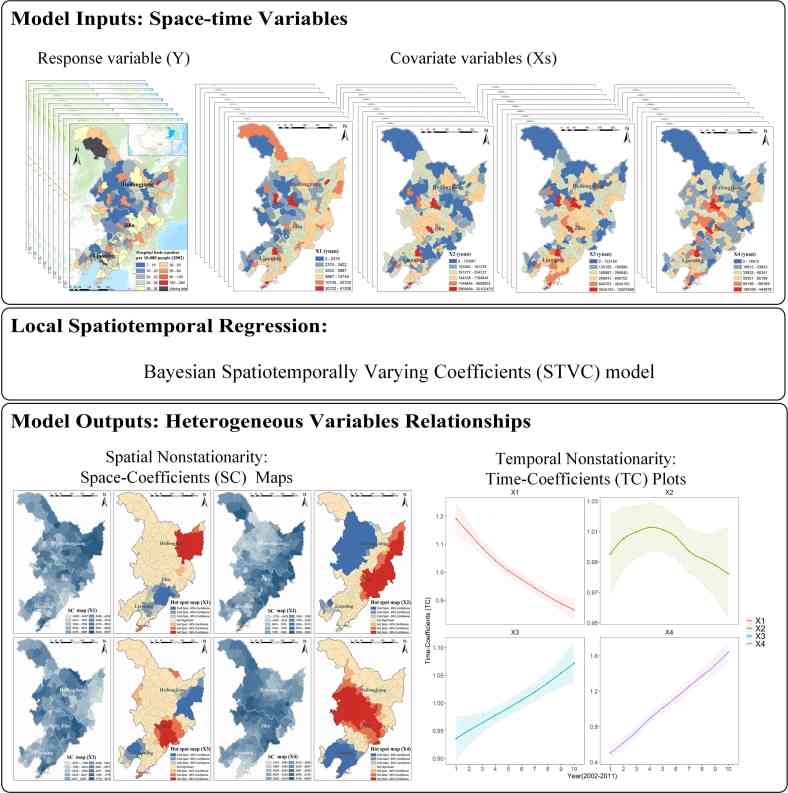
Spatiotemporally Varying Coefficients (STVC) model: A Bayesian local regression to detect spatial and temporal nonstationarity in variables relationships -
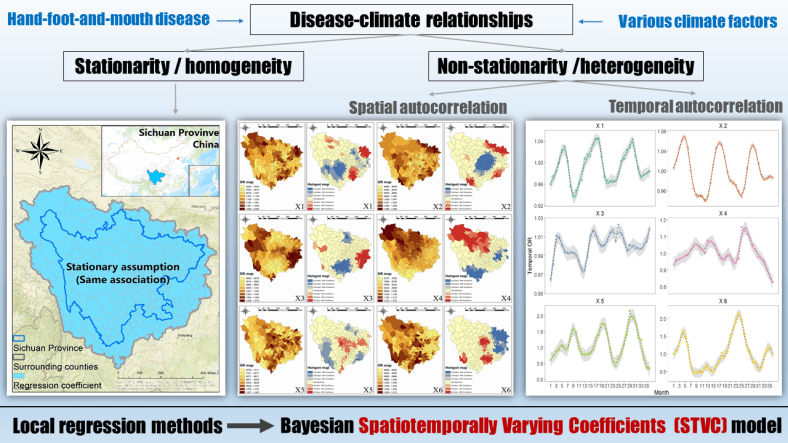
Exploring spatiotemporal nonstationary effects of climate factors on hand, foot, and mouth disease using Bayesian Spatiotemporally Varying Coefficients (STVC) model in Sichuan, China -
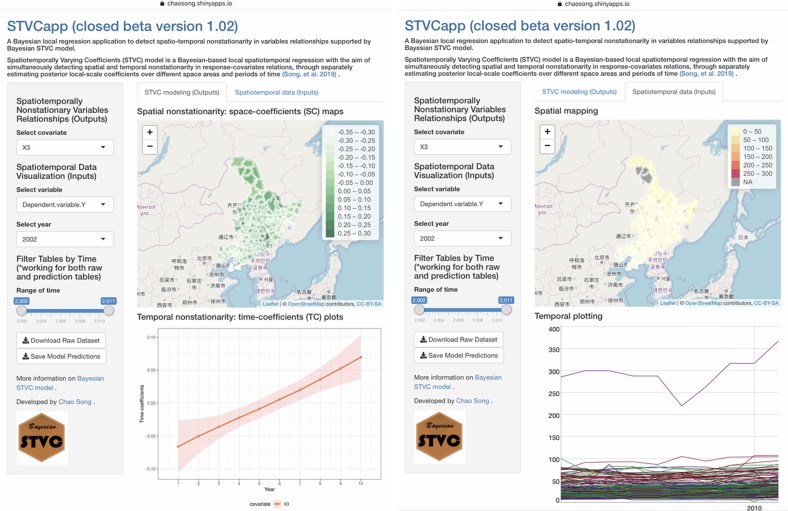
STVCapp: A Bayesian local regression application to detect spatio-temporal nonstationarity in variables relationships supported by Bayesian STVC model -
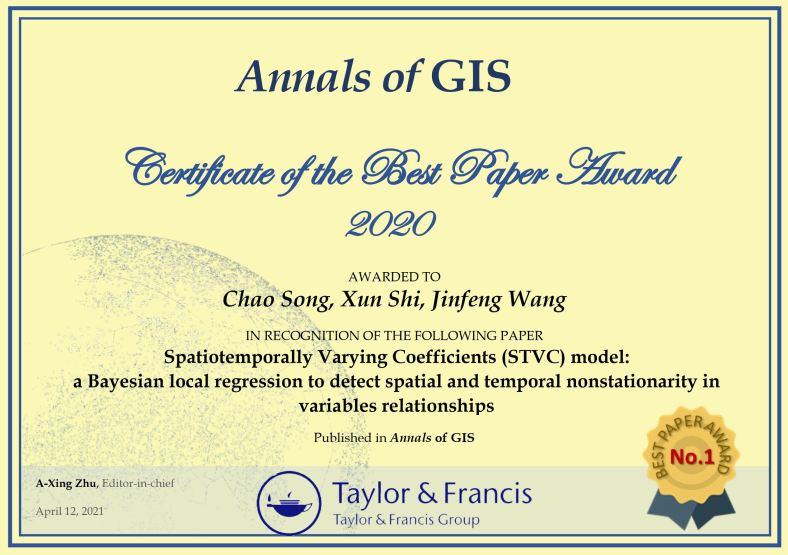
Winning of the best paper award -
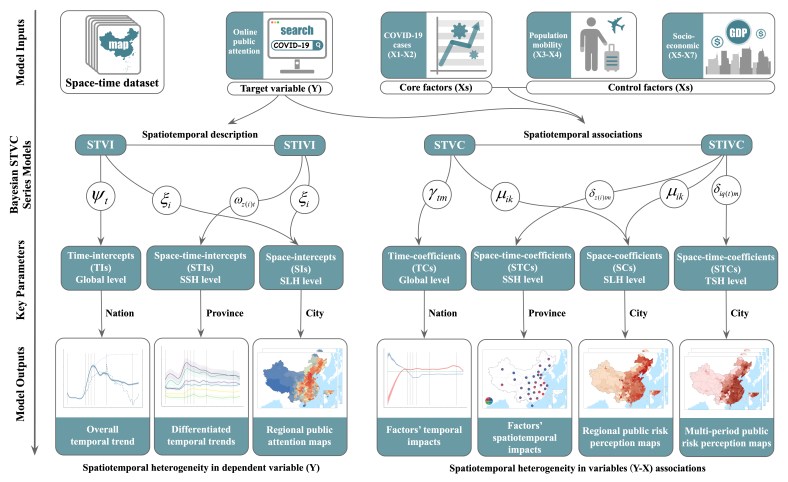
Bayesian STVC series models (2022)
The STVC (Song, et al. 2019, Song, et al. 2020) and STIVC (Song, et al, 2022) models are the two cores of Bayesian STVC series modeling, which are based on the non-stationary assumptions of spatiotemporal independence and spatiotemporal interaction, respectively.
【STVC】Spatiotemporally Varying Coefficients (STVC) model is a kind of Bayesian local spatiotemporal non-stationary regression, aiming to simultaneously quantify spatial and temporal heterogeneous associations between the dependent variable (Y) and various independent variables (Xs) with the consideration of spatial and temporal autocorrelation (Song, et al. 2019, Song, et al. 2020). Compared with the frequentist-based local spatiotemporal non-stationary regressions, Bayesian ones have the advantages of being a real full-map (complete and unified) modeling approach, incorporating prior knowledge and uncertainties (credible intervals on parameters) into modeling directly, as well as being much more flexible in model extensibility (Song, et al. 2020).
【STIVC】A potential limitation of the original Bayesian STVC modeling lies in its assumption of space–time independence. We propose a Bayesian Spatiotemporally Interacting Varying Coefficients (STIVC) model to incorporate the non-stationary random effects of spatiotemporal interaction for covariates (explanatory factors) at the spatial stratified heterogeneity(SSH) level, instead of at the spatial local heterogeneity (SLH) level (the most refined spatial scale) (Song, et al, 2022). Compared with the previous STVC model, in addition to considering space–time interactions, another advantage of the improved STIVC model resides in its flexibility in analyzing complex space–time coupling data organized in two levels, such as counties/cities within states/provinces at the space scale, or days/seasons within months/years at the time scale (Song, et al, 2022).
BSTVC series models with applications in COVID-19
Key improvements to the BSTVC modeling system
Spatiotemporal Variance Partitioning Index (STVPI)
The STVPI can be used as a new screening tool for space-time factors. The traditional methods used for factor selection are based on the hypothesis of stationarity without considering the spatiotemporal heterogeneous influences of explanatory factors. Hence, for spatiotemporal-oriented studies, we recommend the use of STVPI to evaluate the importance of candidate variables, which should be a better option than traditional stationary-based approaches.
The STVPI successfully demonstrated the close associations between socioeconomic development and environment and national ageing globally over the last twenty years and identified the five most critical influencing factors (Wan, et.al. 2022).
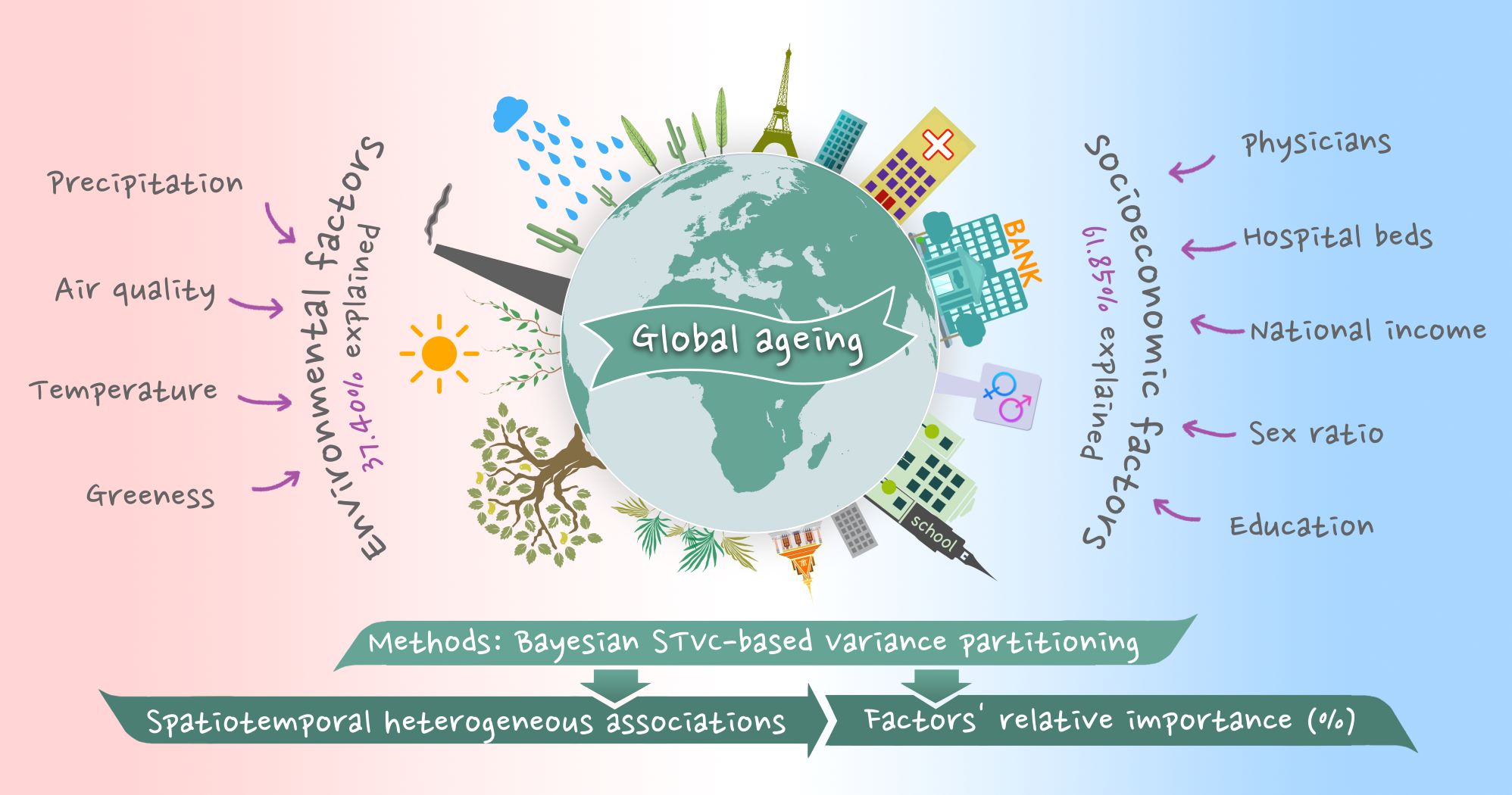
Graphical abstract of the article “Spatiotemporal heterogeneity in associations of national population ageing with socioeconomic and environmental factors at the global scale (Wan, et.al. 2022)”
Theoretical articles (references):
2022: Spatiotemporal disparities in regional public risk perception of COVID-19 using Bayesian Spatiotemporally Varying Coefficients (STVC) series models across Chinese cities. International Journal of Disaster Risk Reduction 2022:103078. DOI: 10.1016/j.ijdrr.2022.103078.
2022 (STVPI): Spatiotemporal heterogeneity in associations of national population ageing with socioeconomic and environmental factors at the global scale, Journal of Cleaner Production, 2022. DOI: 10.1016/j.jclepro.2022.133781.
2020: Spatiotemporally Varying Coefficients (STVC) model: a Bayesian local regression to detect spatial and temporal nonstationarity in variables relationships.” Annals of GIS (2020). DOI: 10.1080/19475683.2020.1782469. (First place in Annals of GIS best paper award 2020)
2019: Exploring spatiotemporal nonstationary effects of climate factors on hand, foot, and mouth disease using Bayesian Spatiotemporally Varying Coefficients (STVC) model in Sichuan, China. Science of the total environment (2019). DOI: https://doi.org/10.1016/j.scitotenv.2018.08.114 (ESI highly cited paper in 2019) (Download PDF)
Online application under development, STVCapp (2020): A Bayesian local regression web application to detect spatiotemporal autocorrelated nonstationarity in variables relationships supported by the Bayesian STVC model.
More information on the Bayesian STVC model homepage (English) and Baidu Baike (Chinese). Welcome to utilize our Bayesian STVC series models for your own research. Feel free to contact us ( chaosong.gis@gmail.com ).