

Section navigation is enabled for this long article; the full text remains continuous.
BSTVC · Bayesian Spatiotemporal Interpretability
Understand where relationships change. See how they evolve.
BSTVC connects local interpretation, global contribution and dynamic prediction in one Bayesian framework for relationships that vary across places and periods.
Explore BSTVC · Get the software · Read the methods
A scientific framework with interpretation built in
Interpretability begins with the model. Bayesian Spatiotemporally Varying Coefficients (BSTVC) models make changing covariate–outcome relationships explicit through spatial and temporal coefficients. Their posterior distributions retain uncertainty in those estimates.
The framework brings together two properties of geographic data: dependence between nearby places or periods, and heterogeneity in their relationships. Its “full-map” approach estimates the study domain within a joint Bayesian hierarchical model, allowing related observations to share information.
- Local interpretation: map where associations differ and trace how they change over time, alongside credible intervals.
- Global contribution: use the Spatiotemporal Variance Partitioning Index (STVPI) to summarize relative contributions to modeled variation.
- Dynamic prediction: connect spatial and temporal structure with smoothing, missing-outcome estimation and prediction under a specified model.
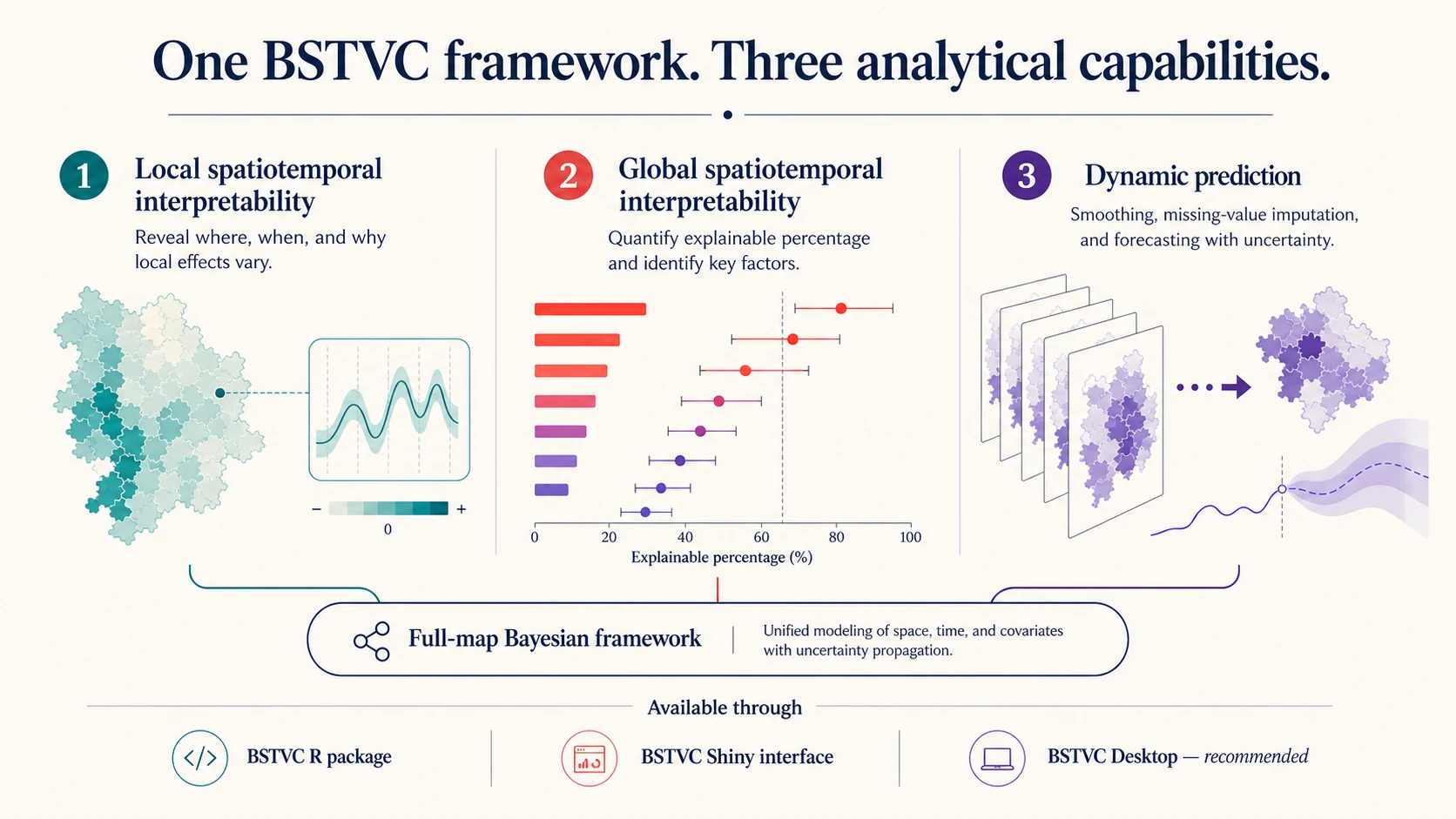
Conceptual illustration from the official website. Explore the three capabilities →
The published model family includes spatial, varying-intercept, varying-coefficient and space–time-interaction formulations. Choose the structure that fits the research question and data. Explore the framework · Read the foundational STVC paper
Published research, real questions
- Environmental health: climate–HFMD associations across Sichuan counties show how relationships vary geographically and over time. Song et al., 2019
- Population ageing: an analysis of 189 countries and territories connects local associations with global factor contributions through STVPI. Wan et al., 2022
- Healthcare resources: hospital-bed data from 2,308 Chinese counties reveal spatiotemporal inequalities, hotspots and heterogeneous associations. Song et al., 2024
These studies span different outcomes and geographic scales; each has its own design, assumptions and evidence. More applications · Publication archive
From methods to usable tools
BSTVC Desktop offers an English and Chinese graphical workflow on Windows: prepare data and maps, check spatial alignment, fit models, inspect results and export tables. Its documented workflows cover continuous, binary and count outcomes.
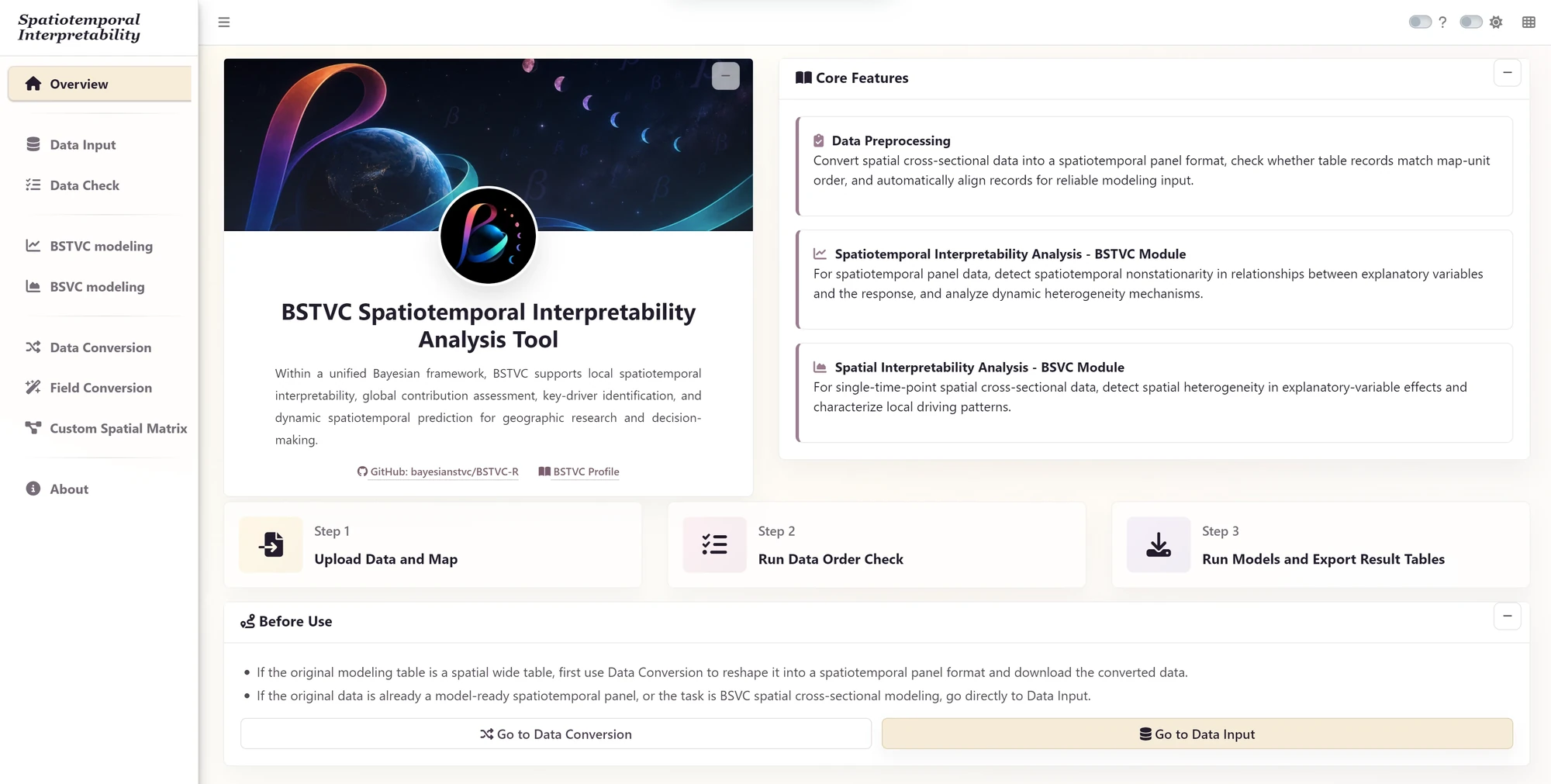
Original software interface. View the product
Download Desktop · English user guide and case data · 中文资源
Prefer a programmable workflow? Use BSTVC-R. For an interactive R-and-browser interface, explore BSTVC-Shiny. Check each product’s current documentation and license for supported capabilities and permitted use.
Explore the English websites

Visit the BSTVC English website →
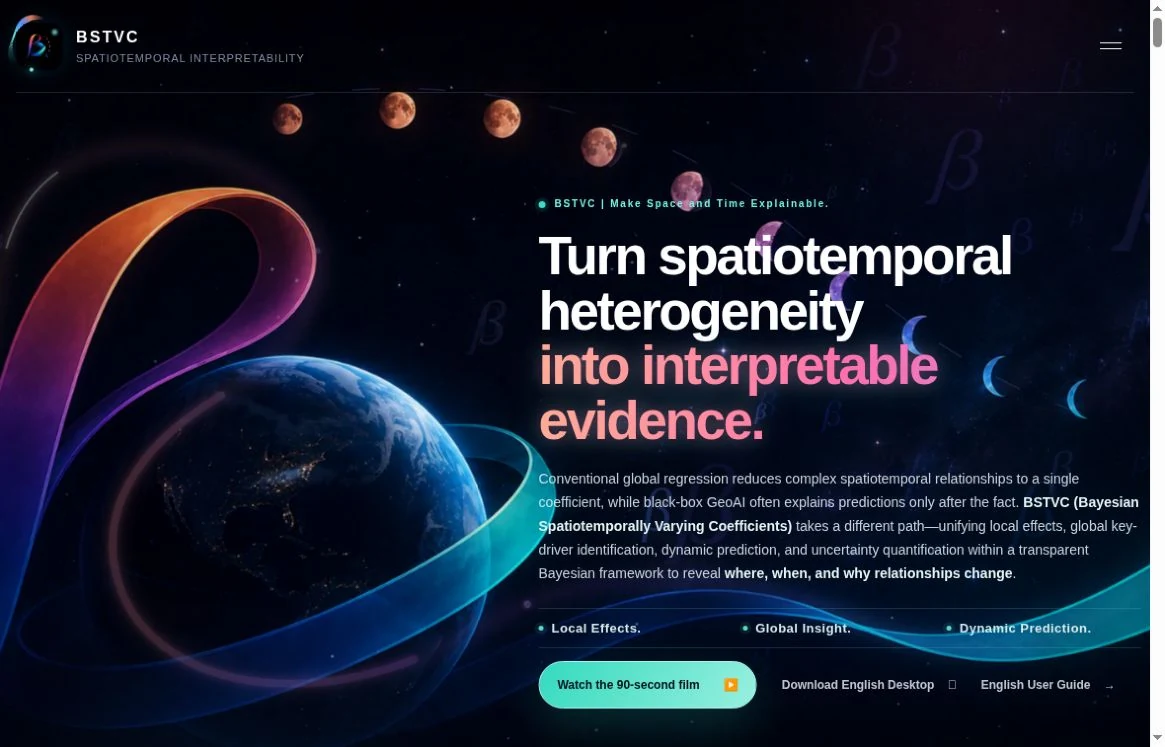
Visit the Desktop English website →
Read results with their uncertainty
Association is not causation. STVPI describes model-conditional variance contributions, not causal shares or forecast accuracy. Interpret estimates alongside credible intervals, model assumptions and diagnostics. Predictive claims require appropriate validation, especially for new places or future periods. Published research extensions may exceed released software capabilities.
People behind BSTVC
Chao Song leads methods and scientific direction; Xianteng Tang contributes software and desktop engineering. The West China Health & Medical Geography Group is part of the HEOA think tank at Sichuan University. The wider research program builds on the work of collaborators and study coauthors.