
Section navigation is enabled for this long article; the full text remains continuous.
BSTVC V2 正式发布:让时空可解释研究走进桌面
BSTVC Desktop V2 is now available. The English Windows x64 installer, version 26.10.25, was published on 4 November 2026, alongside English and Chinese V2 resources. This release connects Bayesian spatiotemporal modeling with a practical graphical workflow and presents three public V1/V2 comparisons of uncertainty in local regression coefficients.
Explore the release: English V2 overview · 中文 V2 专题 · Release notes and English installer
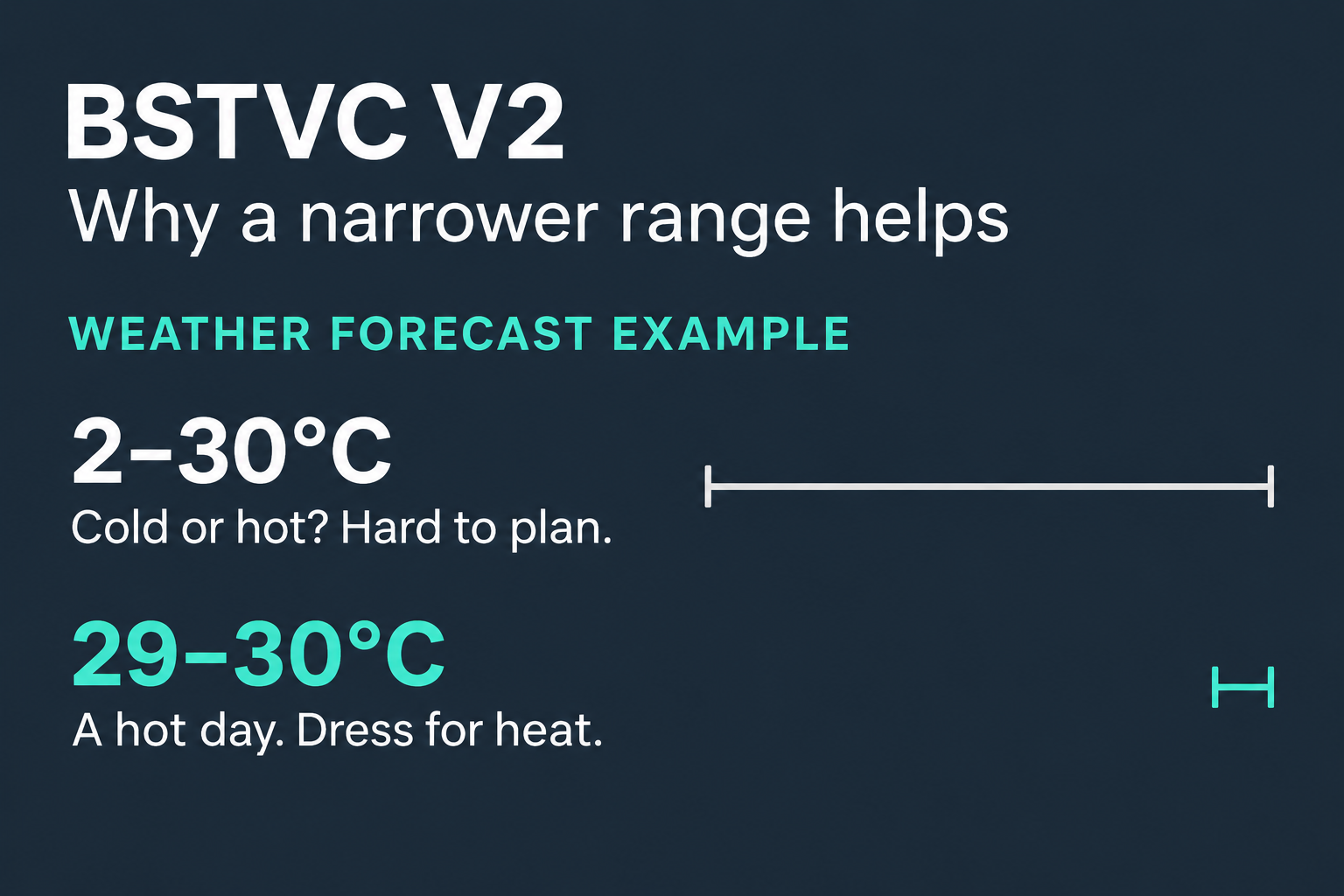
Official V2 explanatory artwork, reused from the website. AI-generated schematic; no case-study data are plotted. 官网原有解释示意图,不是研究数据。
Spatiotemporal interpretability, built into the model
Bayesian Spatiotemporally Varying Coefficients (BSTVC), or 贝叶斯时空变系数模型, asks a concrete question: how do relationships between an outcome and its influencing factors change across places and over time?
The BSTVC series combines spatiotemporal autocorrelation and heterogeneity within a unified, full-map hierarchical Bayesian framework. Local regression coefficients make nonstationary relationships explicit, while posterior distributions retain uncertainty. Its core capabilities connect three research goals:
- Local interpretation: investigate where associations differ, how they evolve, and what they reveal about local spatiotemporal influencing factors.
- Global contribution: use the Spatiotemporal Variance Partitioning Index (STVPI) to summarize model-conditional relative contributions and identify key factors.
- Dynamic prediction: support smoothing, missing-outcome estimation and prediction under the chosen model, with appropriate diagnostics and validation.
The Desktop workflow brings together data preparation, spatial-order alignment, model fitting, interpretation and result export. Documented examples cover continuous, binary and count outcomes. These are the platform’s continuing capabilities; V2’s highlighted comparison concerns reported credible-interval widths. Explore the method and workflow.
What the V2 comparisons show
The official materials compare 95% Bayesian credible-interval widths for temporal and spatial regression coefficients using the same case-study data and matching public analysis settings. Approximate case-level median reductions across explanatory variables are:
- Global health-adjusted life expectancy: 177 countries/territories, 2000–2020; temporal 99%, spatial 38% narrower.
- COVID-19 in China: 31 provincial-level units, January–December 2020; temporal 94%, spatial 87% narrower.
- Hepatitis B in the United States: five Appalachian states, 2012–2023; temporal 99%, spatial 98% narrower.
These are summaries of the supplied three-case comparisons, not a reduction guaranteed for every coefficient or location.
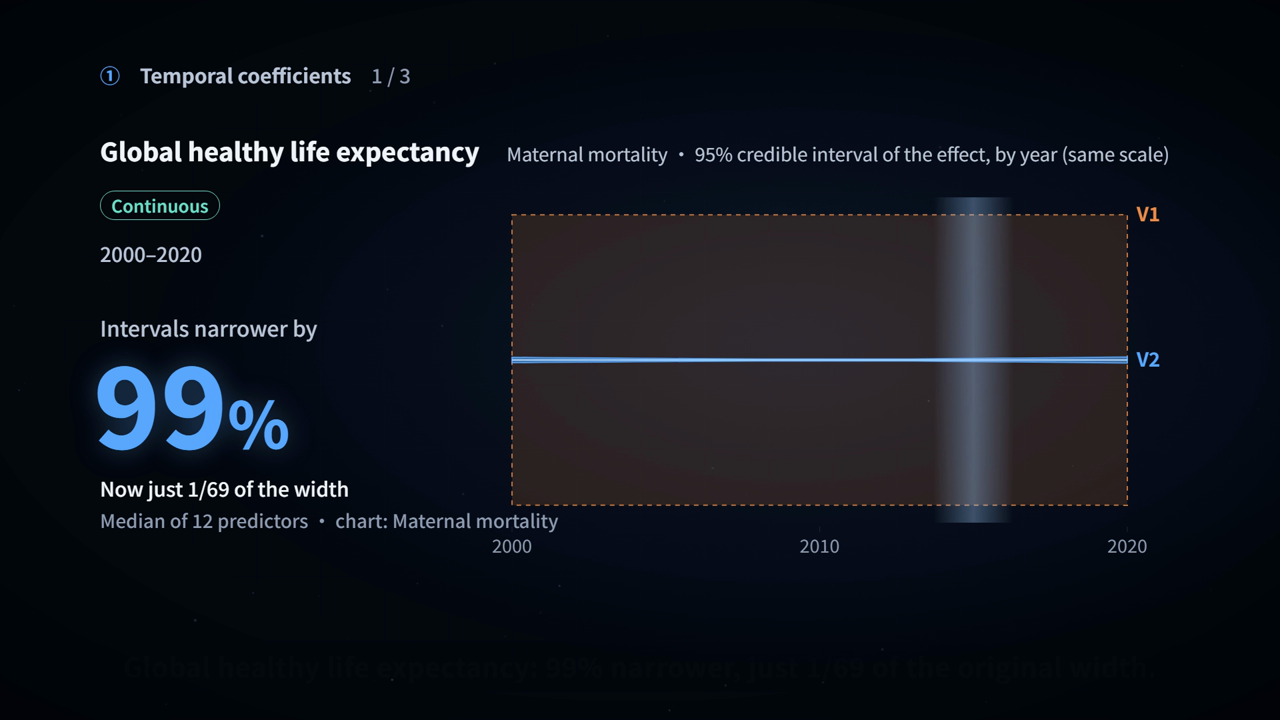
Original English walkthrough frame, 01:13. Maternal mortality illustrates the temporal comparison; approximately 99% is the case-level median summary across 12 explanatory variables. 英文官网原帧:以孕产妇死亡率为示例,约 99% 为该案例 12 个解释变量的汇总摘要。
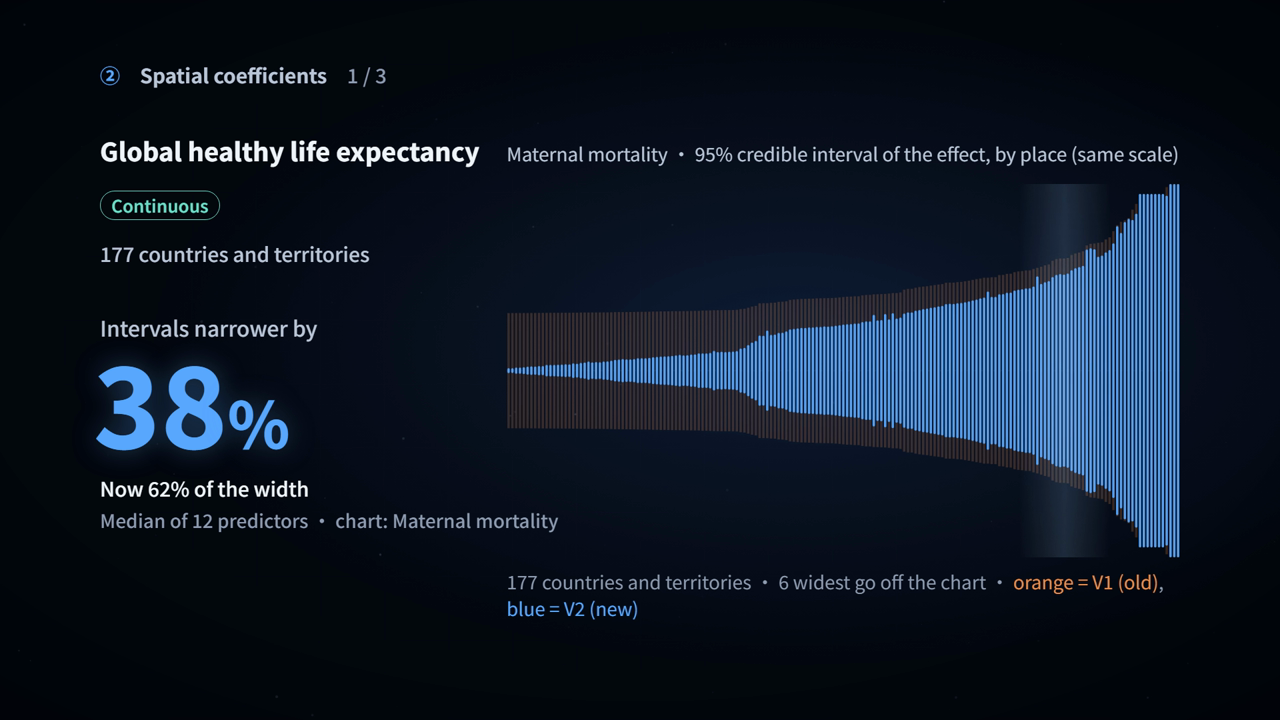
Original English walkthrough frame, 01:56.5. The spatial summary is approximately 38%; six widest intervals are clipped at the plot boundary. Areas without shared-border neighbours are an exception to the overall narrowing pattern. 空间汇总约缩小 38%;原图最宽的 6 个区间在边缘截断,无共享边界地区是整体收窄趋势中的例外。
Read the evidence with its scope. Narrower intervals alone do not establish greater accuracy, adequate calibration or superiority across applications. These plots centre intervals on their respective posterior means to compare widths; they do not establish unchanged coefficient locations or directions. Modelled associations are not, by themselves, causal effects. STVPI contribution summaries are not causal shares or predictive accuracy.
Watch, download and start a study
The V2 pages pair the original comparison figures with narrated videos, captions, text chapters and direct MP4 downloads: 2:50 in English and 2:54 in Chinese. Follow the guide for your language edition, prepare your data and rerun the analysis in V2.
The GitHub release supplies the English Windows x64 installer and its checksum. The Chinese installer is distributed separately through the official Baidu Netdisk link. The English package’s version, size and checksum do not identify the Chinese file. Use the current edition-specific instructions and licence; the repository uses the PolyForm Noncommercial licence.
中文:BSTVC V2,让时空可解释研究走进桌面
BSTVC Desktop V2 已发布。 英文 Windows x64 安装器 26.10.25 于 2026 年 11 月 4 日上线,中英文 V2 专题、讲解视频、案例对比与使用资源现已可访问。本新闻发表于 11 月 5 日。
BSTVC 的标准中文名称是贝叶斯时空变系数模型;其方法体系为贝叶斯时空变系数系列建模。核心问题是:影响因素与研究对象之间的关联,如何随地点和时期而变化?BSTVC 将时空自相关、时空异质性与时空非平稳回归纳入统一全图层次贝叶斯框架,用局域回归系数及其后验不确定性开展时空可解释分析。
三项核心特色:
- 局域时空解释:分析时空异质影响因素,识别关联的方向、强度及随地点和时期的变化,为研究局域时空影响机制提供统计证据。
- 全局贡献分析:通过 STVPI 汇总模型条件下的相对贡献,识别关键影响因素,连接局域与全局解释。
- 动态预测:在选定模型及其假设下开展平滑、缺失结果估计和预测,并结合诊断与验证评价结果。
桌面版将数据整理、空间顺序校验、建模、结果解读与导出衔接为图形界面流程,并提供连续型、二分类和计数型结果案例。
V2 本次重点:三个公开案例报告的可信区间宽度明显收窄。 相较 V1,时间回归系数 95% 贝叶斯可信区间的案例中位数摘要约缩小 94%–99%,空间回归系数约缩小 38%–98%。全球健康预期寿命、中国 COVID-19、美国乙肝三个案例的时间/空间摘要分别为 99%/38%、94%/87%、99%/98%。
以上是各案例解释变量的汇总值,并不表示每个变量和地区都按相同比例变化。区间更窄本身不等于估计更准确或校准已获证实,也不能推出所有场景均更优。 对比图以各自后验均值为中心比较宽度,不代表系数位置和方向不变;回归关联和贡献分析也不能直接等同于因果机制。
中文演示约 2 分 54 秒,英文演示 2 分 50 秒,均提供旁白、字幕与下载入口。中文安装器由独立百度网盘链接提供;英文安装器的版本号、文件大小与校验值仅适用于英文包。请按对应版本指南及许可开展研究。
Official links · 官方资源入口
- V2 release / 版本专题: English overview and video · 中文专题与视频
- Software / 软件下载: English release, installer and checksums · 中文安装器官方入口
- Guides / 用户指南: English guide · 中文用户手册与详细比较
- Data / 案例数据: Three English example datasets
- Desktop websites / 产品官网: English · 中文
- Research ecosystem / 研究生态: BSTVC research initiative · Methods and publications · BSTVC-R · BSTVC-Shiny · BSTVC-Monitor
Research and development: Chao Song, methods and scientific direction; Xianteng Tang, desktop software development and user support. With contributions from collaborators and study coauthors. 研究与开发:宋超负责方法与科学方向,Xianteng Tang 负责桌面软件开发与使用支持,并感谢合作团队及各案例研究作者的贡献。
Announcement: 5 November 2026. Release information and figures verified against the official BSTVC V2 pages and GitHub release. All three illustrations are reused from the existing official website; no new statistical results were generated for this news article.