
Section navigation is enabled for this long article; the full text remains continuous.
BSTVC & Spatiotemporal Interpretability · Part 9 · Chao Song · 1 November 2026
A factor's reported share can double without changing its estimated component, collecting another observation or improving a model. Remove the residual from the denominator, and the percentage changes its meaning. A contribution chart should tell readers which whole its slices belong to.
A percentage needs a named denominator
In the published hospital-bed study, STVPI Equation (6) combines each factor's spatial and temporal component standard deviations and keeps the residual scale in the denominator:
ρₖ = 100 × (σμₖ + σγₖ) / [Σⱼ(σμⱼ + σγⱼ) + σε].
Here, σμₖ and σγₖ are the factor's spatial and temporal scales; σε is the residual scale. This is the published standard-deviation-scale convention, not a sum of component variances. Reproducing it requires preserving both the scale and the included components.
Two denominators, two questions
Take invented component scales A = 1, B = 2 and residual = 3. These are arithmetic teaching inputs, not fitted BSTVC results.
With the residual included, the denominator is 1 + 2 + 3 = 6. A receives 16.7%, B 33.3%, and the residual 50.0%. The two factors together account for 50.0% of this defined scale total.
Now normalize only across factors: the denominator becomes 1 + 2 = 3. A receives 33.3% and B 66.7%. This answers a narrower question: how is the factor-only total divided between A and B?
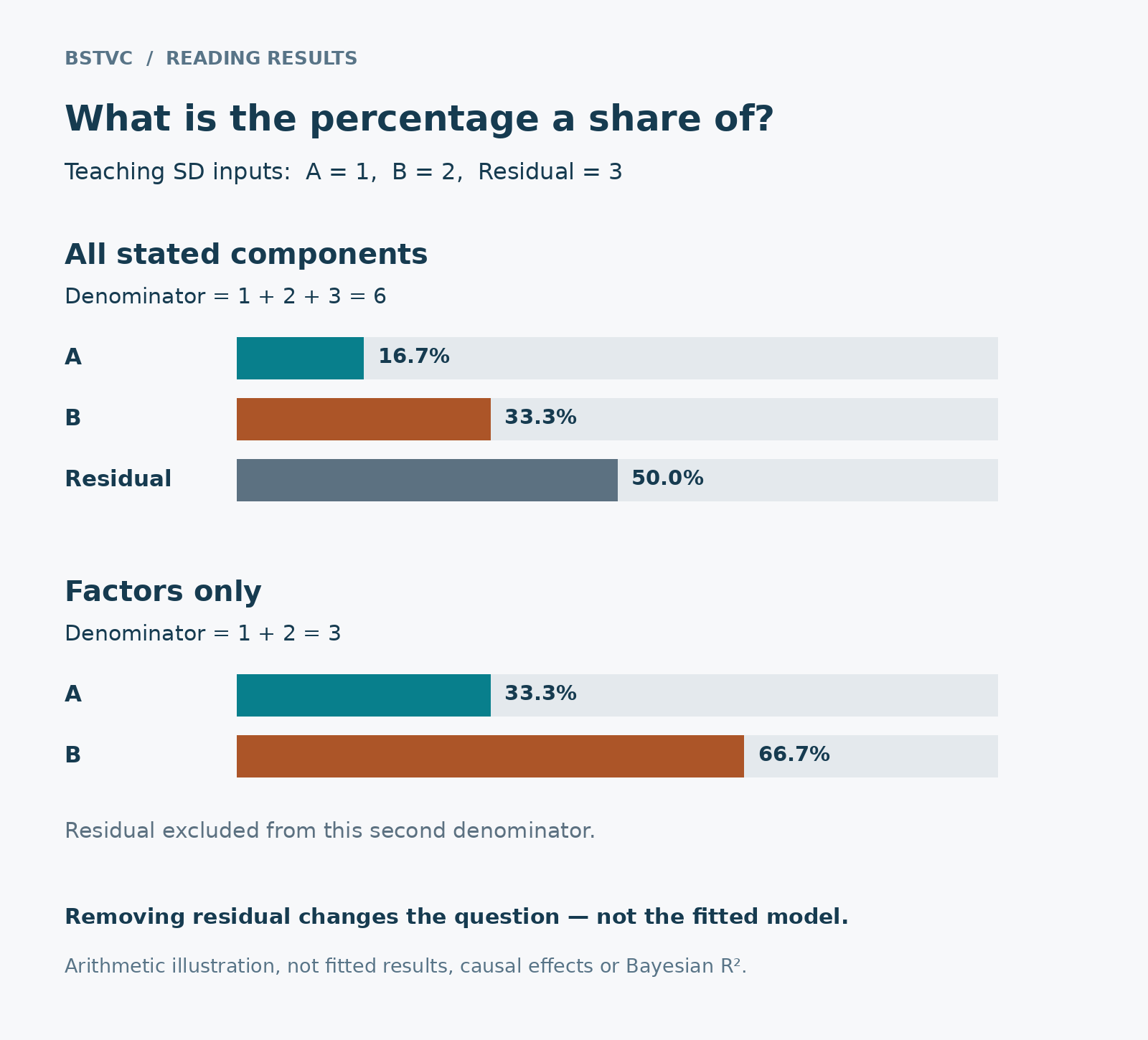
Figure 1. Arithmetic teaching example. The component inputs remain 1, 2 and 3. The residual-inclusive display uses a denominator of 6; the factor-only display uses 3. Percentages are rounded to one decimal place. Omitting the residual changes the reference total; it does not remove residual variation from the model. No empirical estimates or posterior uncertainty are shown.
B's share doubles, but B has not become stronger. The model has not improved. Only the reporting convention has changed. The factor-only chart always allocates 100% among its included factors when their total is positive—even when a large residual remains outside the chart.
Keep both views honest
Let F denote the sum of the included factor scales and R the residual scale. For F + R > 0, the residual-inclusive factor total is 100 × F / (F + R). For F > 0, a factor-only share is 100 × sₖ / F. A zero denominator leaves the corresponding share undefined, not zero.
Both displays can be useful when clearly labelled. In a health-geography report, show the residual-inclusive view first when discussing the full index. If a second panel compares factors only, state that exclusion in the heading and caption. Keep the same component set, scale and grouping rule across comparisons.
Residuals are not a labelled basket of undiscovered causes. They depend on the data and model specification; a residual component alone cannot identify which omitted process, measurement issue or remaining variability produced it. Nor does a small residual establish that the model answers the intended scientific question.
A reporting check before a headline
The complement of a residual share under this convention is not automatically Bayesian R², a causal percentage or held-out predictive accuracy. Those claims require their own definitions and evidence. A normalized sum of component scales is not necessarily a decomposition of observed-outcome variance.
For uncertainty-aware reporting, document how posterior shares and intervals were obtained. A ratio computed from component posterior means need not equal the posterior mean of their ratio. If calculating draw-wise shares, use compatible joint draws rather than arbitrarily pairing separate marginal samples.
Before publishing “B contributes 66.7%,” finish the sentence: 66.7% of what, under which formula?
中文速读
同样的教学输入 A=1、B=2、残差=3,保留残差时 B 占总尺度的 33.3%;只在因素内部归一化时,B 占 66.7%。变的是分母,不是模型能力。因素内部份额可以用于比较,但不能把被省略的残差当成消失,也不能直接称为 R²、因果贡献或预测准确率。
Read, verify and try
This series credits the BSTVC team and the authors of the underlying research. Explore the BSTVC research programme and BSTVC Desktop. Desktop is free for academic and noncommercial use within its applicable licence; third-party terms also apply. Check the current installer notice before planning installation. This article does not verify a software implementation or guarantee an available installer.
Source: Song C, Fang L, Xie M, et al. (2024). Revealing spatiotemporal inequalities, hotspots, and determinants in healthcare resource distribution: insights from hospital beds panel data in 2308 Chinese counties. BMC Public Health, 24, 423. Published 9 February 2024. Original paper, Methods, Equation (6).
Continue the series: Part 8: variance versus standard-deviation shares · Part 7: coefficient magnitude versus contribution · Series introduction.