
Section navigation is enabled for this long article; the full text remains continuous.
Chao Song · 29 October 2026 · BSTVC and Spatiotemporal Interpretability, Part 6 of 24
Two coefficient maps can look similar while answering different questions. Before choosing BSTVC, geographically weighted regression (GWR), or geographically and temporally weighted regression (GTWR), ask: what relationship should vary, over which units, and under which assumptions? A map is an output format—not evidence that the models are interchangeable.
Start with a question, not a winner
Imagine a teaching example: annual disease outcomes and an environmental covariate across districts. No data are analysed here. You might want a spatially local association in one period, an association that changes across both proximity and time, or a hierarchical description with structured spatial and temporal coefficient components. Those are related, but not identical, modelling aims.
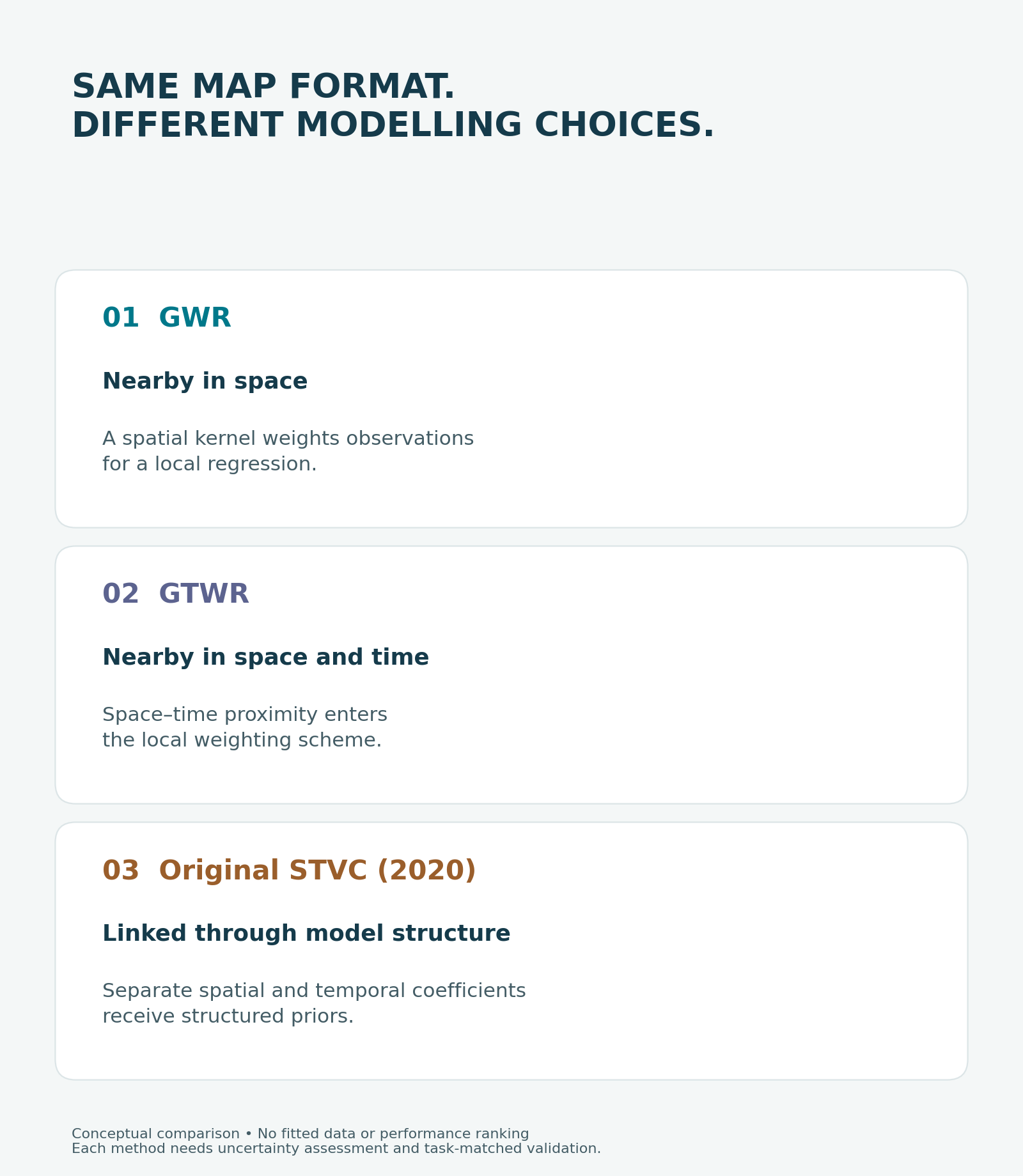
Figure 1. Conceptual comparison, not an analysis result. GWR uses spatially weighted local regressions; GTWR incorporates spatial and temporal proximity in local weighting; the original 2020 STVC formulation links separate spatial and temporal coefficients through a Bayesian hierarchical model. These summaries concern the cited formulations, not every later extension. Diagram created for this article from sources 1–3; no software output or empirical ranking is shown.
GWR: locality through spatial weights
GWR fits local regressions with observations weighted by geographical proximity. The kernel and bandwidth define how local each fit is. Ask whether the geographical distance, neighbourhood support and covariate variation are appropriate for the question. A detailed map does not guarantee that every local estimate is well supported.
GWR is not “a method without uncertainty.” The original 1996 paper includes Monte Carlo tests of spatial nonstationarity. Inference and diagnostics still matter; coefficient colours alone are not an inferential assessment. [1]
GTWR: locality through space and time
GTWR extends local weighting to include temporal as well as spatial information. That makes the definition of proximity consequential: the treatment of spatial distance, temporal distance and bandwidth affects which observations inform each local fit. [2]
For the district example, this may suit a question about locally changing associations over space and time. But including time does not, by itself, demonstrate forecasting skill. A future-prediction claim needs validation that withholds the future information the deployed model will not possess.
Original STVC: structure through a hierarchy
Song, Shi and Wang's 2020 STVC formulation uses a Bayesian hierarchy with separate spatially and temporally varying coefficient components, spatial iCAR priors and temporal random-walk priors. It uses R-INLA for approximate posterior inference. This base additive structure is not an unrestricted district-by-year coefficient surface. [3]
That distinction matters if your question requires a different time trajectory in every district. Check the actual specification and implemented variant rather than assuming that “spatiotemporal” guarantees any desired interaction. Posterior intervals describe uncertainty conditional on the likelihood, priors and model structure; they do not remove the need to examine those choices.
A practical selection test
Before fitting, write down three things:
- Target: the outcome, link, covariates, units and coefficient variation you intend to interpret. Align these before comparing coefficients across methods.
- Support and assumptions: inspect local sample support and collinearity, and assess sensitivity to the relevant kernel, bandwidth, prior or structural choice.
- Validation task: distinguish description of observed associations from prediction at new locations or future times. Choose held-out spatial or temporal units to match the intended use, rather than treating in-sample fit as deployment evidence.
These are proposed checks, not tests performed in this article. There is no universal winner established here: the original STVC paper itself identifies controlled comparisons with GTWR as future work. All three approaches require care with uncertainty and interpretation, and none turns an observational association into a causal effect merely by allowing coefficients to vary.
Next step: write a one-sentence estimand and a held-out-data plan before choosing the method. Continue with Part 4 on additive structure and interactions and Part 5 on coefficient uncertainty.
中文要点
先明确研究问题,再选择方法:GWR、GTWR 与原始 STVC 的局域化方式和结构假设不同,不能只凭系数地图或拟合优度排名。核对实际模型是否支持所需时空交互,并用匹配应用目标的验证设计评估;关联不等于因果。
Sources and software
- Brunsdon, C., Fotheringham, A. S. & Charlton, M. E. (1996). Geographically Weighted Regression: A Method for Exploring Spatial Nonstationarity. Original paper / DOI · Repository full text.
- Huang, B., Wu, B. & Barry, M. (2010). Geographically and temporally weighted regression for modeling spatio-temporal variation in house prices. Original paper / DOI · Author-hosted full text.
- Song, C., Shi, X. & Wang, J. (2020). Spatiotemporally Varying Coefficients (STVC) model: A Bayesian local regression to detect spatial and temporal nonstationarity in variables relationships. Original paper / DOI.
Sources checked 29 October 2026. The comparison uses the original papers, including an accessible author-uploaded full text of the STVC paper; the publisher's full-text endpoint was not accessible during checking. This is a methods guide, not a comparative benchmark.
BSTVC is developed by the BSTVC team. Explore the organisation website and BSTVC Desktop. Free use is limited to academic and noncommercial purposes, subject to the applicable terms. The current Desktop repository specifies PolyForm Noncommercial 1.0.0; consult that version's licence rather than assuming unrestricted GPL terms.